Ready for every eventuality: investment is the key to resilience in construction
In an ever more volatile and unpredictable world, businesses in construction could be forgiven for retreating into caution. Adam Taylor, Director at TSM, explains how a bolder approach can pay dividends in times of instability.
It’s no overstatement to say that the past 10 years have been a decade of massive upheaval and uncertainty. Brexit, Covid, and wars in Ukraine and the Middle East have caused long-term economic shocks, accelerating price rises and supply chain disruption.
UK construction has felt the impact especially keenly. Since 2016, our sector has faced sustained upward pressure on costs and ongoing supply-chain volatility, with input prices rising markedly and remaining structurally elevated rather than reverting to pre-2016 levels. Material and input costs spiked during 2021–22 amid global shortages before settling at a higher baseline influenced by continued energy and logistics pressures. Recent data still show modest but persistent annual increases in construction input prices into 2025–26, alongside industry evidence of renewed cost inflation and tightening supply conditions. This indicates that volatility and higher pricing have become embedded features of the sector rather than cyclical fluctuations.
In this economic climate, many construction businesses instinctively adopt a defensive crouch. Belts are tightened and ambitions are tempered. That perceived survival mode is counterproductive: it makes businesses less robust in challenging times.
TSM was founded in July 2020, at the height of the pandemic. We were stepping into the construction market amid global uncertainty. I won’t pretend that we had all the answers. Starting a business during such a challenging time was a steep learning curve, but it sharpened the clarity of our thinking. One of our earliest lessons has stayed with us ever since: we soon realised that our ability and readiness to adapt was an essential attribute – one that needed to be continually developed to maintain our resilience. That realisation imbued a proactive mindset. Rather than scaling back, our instinct has been to take more control at every opportunity, no matter what the wider economy is doing.
The same instinct has driven the company’s growth ever since, setting in train a policy of continual investment in infrastructure, equipment, and systems to enhance our self-sufficiency and resilience, and keep operations moving come what may.
Investing in fleet and plant
Like most construction companies, TSM has used its fair share of leased equipment. The lower upfront cost looks appealing on a quarterly spreadsheet, but over time we have grown to appreciate how much it pays off in the long-term to own your tools. First and
foremost, it gives you the ability to deliver work without delays – an attribute that earns trust, strengthens credentials and wins repeat business. From the latest hydro-demolition equipment to advanced coating technology, we have acquired a wide range of plant to reduce reliance on third-party hire companies and protect us from supply chain shortages. That strategy has not only made us more robust but also nimbler and more efficient in our operations, enabling us to respond faster to urgent work and apply more rigorous quality control across every project.
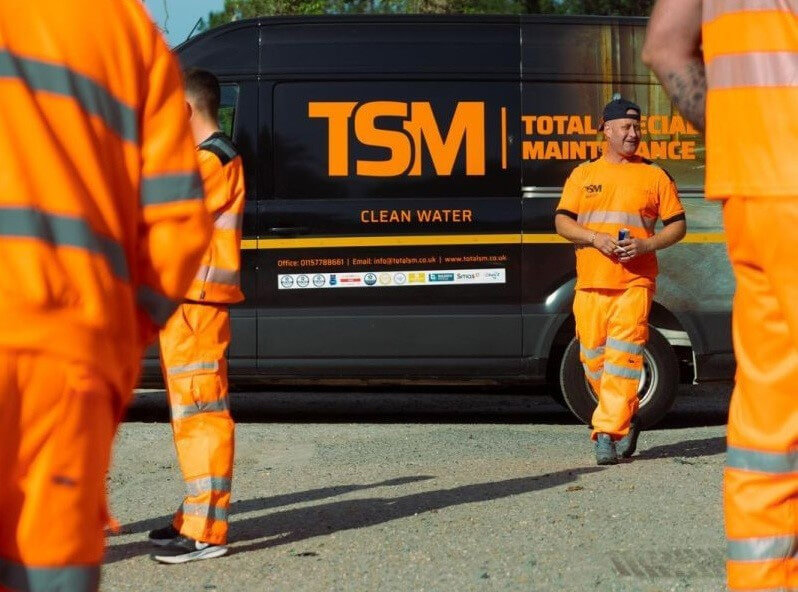
We’ve applied similar principles to the expansion of our fleet, with year-on-year acquisition of welfare vans. It’s another measure to insulate TSM from supply chain vulnerabilities while giving us full control over scheduling and response times, and greater reliability when attending sites. It allows better maintenance planning to keep machinery in optimal condition and enhances our asset value. It also provides a competitive advantage when bidding for projects: in recent years, our ability to demonstrate independence, versatility, and readiness has been a critical factor in winning major contracts. That represents a significant return on investment, often overlooked as a potential gain.
Securing fuel supply
The blockage of the Strait of Hormuz has reminded us of the vulnerability of the global economy to regional disruption. Fuel costs and availability have become a growing concern across construction, which relies more than most industries on a seamless supply.
TSM has addressed this directly by investing in our own on-site diesel tank, enabling us to manage fuel costs more effectively and keep vehicles and equipment running at all times. Its cost is far outweighed by the risk of operational disruptions caused by fuel shortages. Project failures, delays, and missed deadlines carry a less tangible cost to reputation and client relationships, which ultimately lead to an immeasurable loss of business. Amid rising fuel uncertainty, having our own diesel supply has dramatically reduced that risk.
Strength in stock
Another key part of TSM’s strategy has been building a significant stockholding of essential materials and components to support our maintenance services, from waterproofing solutions to chemical-resistant linings. Bulk purchasing critical materials reduces our exposure to price fluctuations and unpredictable supply delays. We have substantial stock ready for immediate deployment, maintained in optimum condition, through advanced temperature controls installed in our warehouse.
Immediate availability of materials is a competitive edge driving business growth: it increases the speed of our response and enables tight cost control, with bulk buying helping to keep pricing competitive for clients.
Every investment TSM has made in the past five years forms part of a joined-up strategy: reduce dependency, increase control, and keep delivering regardless of external pressures. We’re continually seeking ways to be more self-sufficient, more flexible, and better prepared for the unknown.
No company is immune to external forces; like every construction business, TSM has been impacted by global turbulence. Unforeseen challenges will always arise, and some will probably bring new lessons for us to learn. However, we do everything within our power to ensure we are properly resourced to respond.
When we started out in the summer of 2020, we found that, in uncertain times, certainty was the most important benefit we could offer our clients. That principle remains true today: certainty of cost, certainty of supply, and certainty of capability are more valuable than ever.